
If you have a hankering for the sand and mud, this thoroughly updated edition of The Four-Wheeler’s Bible is your ultimate resource for overland adventures, both close to home and farther afield.
Whether you are a seasoned veteran or a four-wheeling novice, you will find the information you need to maximize your enjoyment of your next off-road excursion. Author and four-wheeling experts Jim Allen and James Weber begin with a primer on emergency preparedness before combing through all considerations you should take aboard, from trail etiquette to the latest technologies. Allen and Weber explain the concepts of four-wheel-drive systems in easy-to-understand terms and go on to suggest modifications to make off-road rigs more capable, comfortable, and dependable for intended application.
This third edition is completely redesigned and updated to offer explanations of the latest electronic GPS and communications gadgetry, advice and techniques for planning and negotiating overland routes, and updates for new off-road vehicles that will help you get the most from your four-wheeling experience. With you machine up to snuff, you will be ready to hit the trails. Allen and Weber demonstrate the correct way to handle countless common off-road situations. And because everyone makes a mistake eventually, they also show how to get out of a variety of sticky situations. There’s more to the four-wheeling experience than modifying and driving a vehicle, and the authors leave no rock unturned, ensuring that you are equipped to handle nearly any trip, no matter how far into the wilderness you choose to venture.
The Four Wheeler’s Bible is an indispensable piece of gear if you’re planning to hit the trails!
From the Publisher
What is Four-Wheel Drive?
Four-wheel drive doubles the amount of traction available to an ordinary two-wheel-drive rig by providing a second driving axle. What is traction? It can be defined a few different ways. For the purposes of our Traction 101 discussion, let’s call it the transformation of engine torque into vehicular motion. Most of that transformation occurs where the tires meet the ground. Therefore, the tire’s grip on the ground surface plays a big part in the traction equation, as does the number of gripping tires that have power applied.
The basic and perennial four-wheel-drive system consists of three components. First is the transfer case, which splits the power from the engine to drive the other two components, the front and rear axles. The transfer case may also contain a selectable gearing-down mechanism called low range, which drops the overall gear ratio.
ON WATER CROSSINGS: Before taking the plunge, evaluate the water depth, the bottom condition, and the exit on the far side.
Don’t drive where you won’t dive! If you have to get out and check water depth the old fashioned way, so be it. Just make sure it’s safe for you to do so. Take note of water depth, bottom conditions, the entrance and exits from the water, and the current.
When you enter the water, do it sedately. Dipping in at an angle will momentarily place the engine compartment in a low position, and a slow entrance will reduce the “tidal wave” effect in the engine compartment if the water is deep.
Once in the water, maintain a reasonable momentum, just enough to generate a modest bow wave. The bow wave is mostly an indicator of correct speed. Too fast, and you are pushing water into areas you don’t want it. In some vehicles, the bumper pushing water creates a depression under the engine compartment, keeping the water level lower than it might otherwise be.
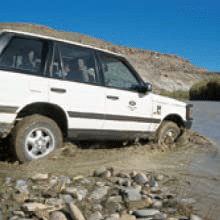
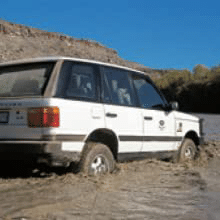
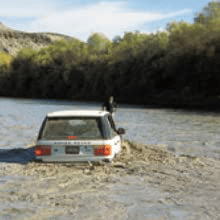
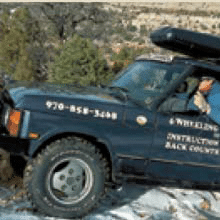
When current is present, a diagonal approach is best. In areas of very fast water, a vehicle broadside presents a greater surface area for water to push against. This force can overcome what little grip your tires have on the bottom and push you downstream. This Range Rover is in to the tops of the tires and is somewhat past its maximum rated fording depth.
Basic Vehicle Tuning and Buildup: The Toolbox
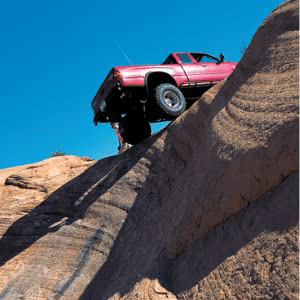
Modification 101The first lesson in modifying any vehicle is that you have to think beyond just one part. The whole vehicle must be balanced in strength and ability according to the uses you plan. When you get right down to the core of off-highway performance, there are only two things you need in a four-wheel drive: traction and clearance. Make improvements in those two areas and you’re set.
Most of us don’t have unlimited funds, so modifications must be chosen carefully to bring a good result for the money spent. The two most common mistakes are buying something on the basis of popularity instead of need, and buying based on bottom-line
cost. Popularity sometimes represents a commonality of need, but sometimes it represents merely what’s “cool.” What’s cool may also serve a use or need, but maybe not for you.
As to cost, remember the old apples and oranges adage. Unless you are looking at nearly identical products, don’t shop on the basis of cost alone. Look first at what you get, and then check the cost and compare it to the other items that fit into the same general category.
Remember, you get what you pay for! Some products are designed and built simply to be the lowest-costing item on the market and the prime candidate for those who shop by cost alone. They are often far from being the best in terms of performance. Moderation of goals is a far better form of thrift than selecting the lowest-costing products in any category.
Recovery Techniques: Inertially Challenged – THE BASIC WINCH OPERATION
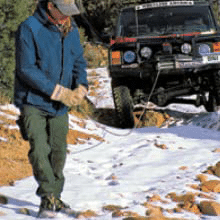
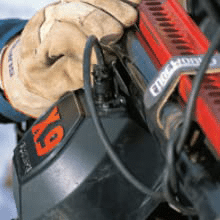
You’re stuck! Step one is to release the clutch on the motor so that the cable will freespool. How this is done varies from winch to winch. Once you’ve determined what you will use as a dead man, freespool the winch cable to that location. Gauge the difficulty of the pull, and if it will be a difficult pull, either spool out to the last layer on the drum for maximum power or use a snatch block to double the power.
Disengage the freespool on the winch and plug in the winch control. Route the wire so that it won’t be caught in the drum, a tire, or anywhere else. Take up the slack in the cable and add a blanket, coat, or purpose-built kinetic energy damper to the cable.
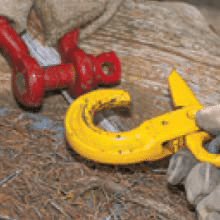
Make a secure hookup to a solid object that won’t move or be uprooted. If it’s a living object, use a strap so it won’t be harmed.
The safest place to winch from is the cockpit. If you are solo, you will have to stop periodically to make sure the cable spools correctly on the winch drum. If you use poly rope, this is less important because crushing cannot damage it.
Publisher : Motorbooks; Revised, Updated ed. edition (June 1, 2021)
Language : English
Paperback : 256 pages
ISBN-10 : 0760368058
ISBN-13 : 978-0760368053
Item Weight : 2.1 pounds
Dimensions : 8.3 x 0.75 x 10.65 inches